
Getting youth leadership right starts with clarity about power
Introducing a new model to support ethical and developmental youth participation.
Progress has been made to give young people greater influence within the services and organisations designed to support them. Yet when youth engagement is under-resourced or poorly defined, it risks causing harm. Part of the challenge is a lack of clarity about what different forms of youth engagement offer, and what it really means to share power. And when we are not clear about what we mean by “youth power”, we risk diluting and co-opting the concept altogether.
Through a partnership with BBC Children in Need, Renaisi-TSIP has developed a new inclusive youth leadership model to help young people and professionals approach this work in a developmental, responsible and honest way. In this article, Cathy Hearn introduces the model, explains why clarity about power matters, and provides a practical resource to get started.
Building youth power should be a developmental process
Organisations cannot embed meaningful youth leadership overnight. Young people also need support to build the confidence and skills required to lead. This work requires time, resources and specialist skills. This is skilled, demanding and complex work.
Attempting too much too quickly risks disappointment or harm for the young people involved. We’ve seen examples of organisations over-committing and under-delivering, of young people not being compensated or credited for their contributions, of communication vacuums, and of mismanaged expectations around what young people can hope to influence. All this can actively undermine the objectives of power sharing – eroding trust and confirming young people’s fears about working with adults and authority figures.
Unfortunately, these pitfalls are common across the social sector youth engagement approaches.
It is therefore important to distinguish clearly between lighter touch models of youth engagement – consultation and contribution – and more participatory approaches, where young people are partners in or drivers of the work. Organisations must be honest with themselves and with young people about what each approach requires and what is realistic.
Defining power, then sharing it
Before organisations begin engaging young people in any form of leadership or participation work, it is essential to define what “power” and “power sharing” mean in practice. Adults often hold unspoken assumptions about what can and cannot be influenced, what decisions are genuinely open for co-production, and where young people’s leadership has real scope. When these boundaries are not explicit or legible to young people, participation can easily feel superficial. Being clear about the type of power on offer – and its limits – is a critical first step in ethical youth leadership work.
The inclusive youth leadership model
Renaisi and TSIP have supported many organisations to develop and evolve their youth leadership and participation approaches, including Mission 44’s youth advisory board, the #iwill Fund’s young evaluators network and the evaluation of the Youth Endowment Fund’s Peer Action Collective. Through these collaborations, we have refined our understanding of what it takes to build youth power effectively. The model presented here was shaped through our partnership with BBC Children in Need’s Youth Social Action Fund.
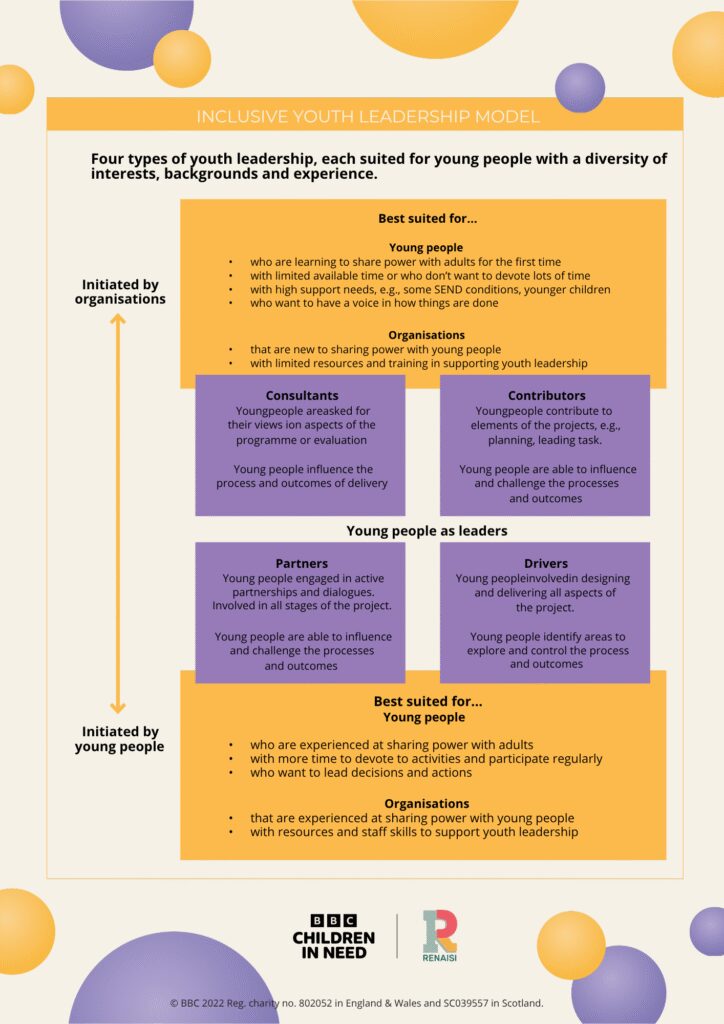
Our youth leadership model outlines four modes of youth engagement, building on existing participation and youth leadership frameworks:
- Consultation
- Contribution
- Partnership
- Leadership
The model adds two elements we feel are essential: a developmental framing, and a clearer focus on the conditions and resources organisations need to use each mode responsibly. We also seek to make it explicit which modes constitute genuine power sharing, and which do not.
This distinction matters. Consultation and contribution can be valuable developmental steps for both young people and organisations, but we do not see them as genuine power sharing. Over-claiming is a form of tokenism, and it undermines ethical participatory practice. Partnership and youth-led work offer more meaningful opportunities for young people to influence decisions, provided the conditions are right.
How might you use this model
The model asks staff and young people to consider the conditions currently in place to enable youth leadership, and whether the level of power on offer matches these conditions.
For organisations, this means reflecting on:
- Have staff shared power with young people before?
- What time and resources are realistically available?
- Do staff have the skills and experience to work well with young people, including those with mental health challenges or who are neurodivergent?
For young people, it means considering:
- Have they experienced power sharing with adults before?
- Do they want to devote significant time to the project?
- Would they benefit from specialist support, for example relating to mental health or neurodivergence?
Answers to these questions should guide decisions about the most appropriate form of youth leadership.
Organisations with limited capacity or experience may need to begin with consultation or contribution, with a plan to shift towards partnership or youth-led work as conditions shift. For younger children, for some disabled young people, or for young people with limited time or interest, lighter touch models may be the most appropriate end point. Our research suggests that this can be both ethical and effective – if it is intentional and transparent.
We have developed a short quiz to help young people and organisations assess their readiness for different forms of youth leadership. We would welcome the opportunity to test and improve these tools. If you would like to work with us to try them out, please get in touch.

- Get in touch
- Contact Cathy Hearn on:
- 0204 524 4922
- c.hearn@renaisi.com