Community of Practice: Models for long-term place-based funding
In our most recent Community of Practice meeting, Principal Consultant Place & Systems Change, Kezia shared findings emerging from our current inquiry into sustaining place-based systems change. This inquiry, which is running till spring 2026, is mapping out the approaches that places have used to sustain local systems change work over time.
Building on those shared during the last Community of Practice, in this session, we introduced three models for resourcing place-based systems change drawn from external literature on historic public and philanthropic funding for place-based change:
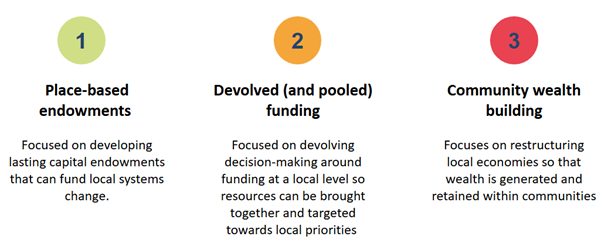
These models, alongside those shared in the previous session, are just a snapshot of those that have emerged in literature. As the inquiry progresses, they are likely to evolve and develop. Within the Community of Practice, we used them as a starting point for discussions about long-term resourcing for place-based systems change.
Reflections from the community
Breaking into small groups, the Community of Practice reflected on the three models, exploring what resonated, where the models fell short and how they should develop to respond to the shifting needs of place-based systems change work on the ground.
The need for local ownership and oversight
Community members questioned how to ensure that models for place-based systems change rooted in funding from external sources could be designed to ensure community voice genuinely directs the work. There were concerns about whether ‘top-down’ funding models can genuinely devolve power, as tensions around decision-making often persist even when anchor organisations are granted that authority.
Suggestions from community members included exploring models that combine small injections of funds and then for the funders to give decision-making power to the community, to enable them to take the lead.
Ensuring that accountability for how funding is spent and the change it supports sits with the community in a place is critical, particularly if funding comes from external sources. This will enable sustainability and limit disruptions when there are transitions in sources of funding.
Sustaining through relationships, connections and values
Relationships are integral, and the sustainability of place-based initiatives hinges on the level of trust established between residents, community organisations, local authorities, and other key stakeholders. These relationships tend to endure and can provide a platform for future activity. It was reflected within the Community of Practice of how local organisations often play a critical role in navigating gaps between funding streams, ensuring continuity and helping communities maintain momentum during transitions.
Members of the community particularly highlighted that place-based systems change is often driven and sustained by passionate individuals who deeply care about a place. They highlighted that local people choosing to dedicate time, skills and energy to supporting deep-rooted, local change, often for free, is a critical element of sustaining systems change.
Developing models for place-based systems change should support a culture that encourages local people to take up roles, sometimes informally, in delivering change. But alongside this, we cannot assume that goodwill alone will sustain change or rely on passion rather than pushing for those driving systems change to be appropriately compensated.
The community recommended that our inquiry investigates the cultures, principles and values that can sustain change. They flagged that understanding why people are involved in systems change work and how to build a culture that cultivates passion and commitment will be critical to understanding how place-based systems change can be sustainably resourced.
Being led by ambitions for systems change
There was a strong call from the group to use the inquiry to learn about the strengths and failures of previous approaches to place-based change. Our inquiry is investigating how places, policymakers and funders have tried to sustain place-based change. Through interrogating how previous approaches have both enabled and withheld systemic change, this inquiry will build a set of updated models that develop on learning from the past while meeting the needs of the present.
In line with this, one breakout group posed an important question: can we begin by defining what we want to sustain before deciding how to sustain it?
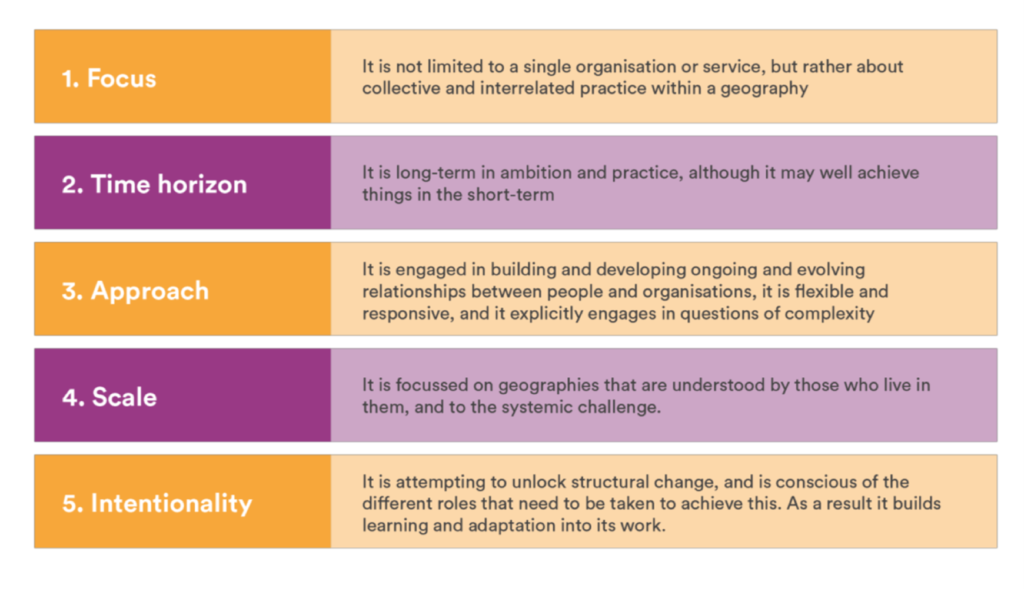
This inquiry is focused on sustaining place-based systems change, defined by our 2020 inquiry as an approach to social change which is:
We are focused on place-based systems change as an approach to social change that must shift entrenched power dynamics, processes, attitudes and relationships, to drive deep-rooted and transformative change. In aiming to develop models to sustain place-based systems change, we aim to support models which will support this way of working to last and grow.
Next Steps
We’ll continue to test ideas that come out of the inquiry through the Community of Practice, sign up to our next session on 10 February 2026, from 12-1pm on Zoom, to get involved.
If you’d like to have a more active role in our inquiry, through shaping our research questions, sharing your experiences or participating in an interview, get in touch – we’d love to hear from you.